What Book Is the Soldier in Good Omens Reading?
In the beginning, there were volcanoes. Ruthless, sulfurous vents that blew rock and ash heaven high and that oozed magma into the sand that was in one case the floor of an ancient sea.
Thousands of years after, I walked into Large Bend National Park and found a paradise of sorts. Cradled in the basin of the Chisos Mountains lies a deciduous woods, encircled by scrub desert mountainsides. At the acme of these giants are grassy plains, an Eden-like harbor of life in the West Texas desert. I hiked to the top and watched the sunset over the mountains of Mexico on the other side of the Rio Grande.
Hundreds and hundreds of miles north and west, along the shores of the Columbia River that divides Oregon from Washington, and all throughout the long mass of California, forests and tree-lined ridges are blackened and scarred from months of fires. Fires caused by years of drought, acquired by changes in the climate. And all over the state, the world, at that place are few natural refuges or idylls that are unscarred. There are a thousand trivial ways that we've made this world worse.
It'south all around usa, the splendor of nature and the evidence of the harm we've washed. And the more I see, the more I think about Adam Immature.
Over this last year, I've been all over the U.S., driving from national park to national park. I've seen subterranean caves, primordial cypress swamps, canyons cutting by the Rio Grande, the scenic grandeur that is the Redwood tree. Just I've besides seen skylines of belching smokestacks, pesticides rained downward upon fields, more than street corner litter than you could fill a small-scale rare books shop with. It'due south all effectually us, the splendor of nature and the testify of the harm we've done. And the more I run into, the more I call back nigh Adam Immature, the boy protagonist of Neil Gaiman and Terry Pratchett'southward 1990 comic novel Good Omens, and too the Antichrist.
Adam Young has been on my mind considering of his anger nigh the environment. My anger has been a irksome, boiling thing, while Adam's ignites quickly and burns bright. Earlier he turned 11, "no one had even used the word environment in Adam's hearing before." And then he meets occultist Abomination Device, who opens his eyes to the world exterior of himself in a unmarried chat. She tells him all about the hole in the ozone layer and dying whales, gives him some New Age magazines to read, and she'southward unwittingly made an antinuclear environmentalist. He wants a better earth to grow up in.
Practiced Omens hasn't only been in the back of my mind, merely in the forefront of a lot of other people's as well. The long-awaited miniseries, written and produced by Neil Gaiman, was released on Amazon Prime at the cease of May. The show's popularity has also put the book on the New York Times best sellers list for the kickoff time.
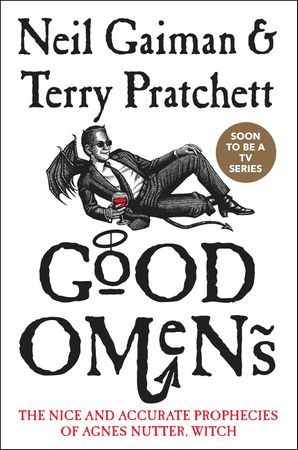
To be live in 2019 means having the world's cease, or at least its destruction, on your brain's dorsum burner. It'due south difficult to read Good Omens and non run into our contemporary world. In an interview with The Guardian about the Good Omens miniseries, Neil Gaiman noted that "the weirdest thing is how a novel that was written literally 30 years agone feels actually a lot more apt now than it did so … I hateful, if I could trade, I would have a much duller world in which we had to try and convince people that an apocalypse was likely, instead of having the world that we're in, where the nuclear clock is ticking closer and closer." The jokes and tactics that Pratchett and Gaiman used to convince their readers that the end of the world could be nigh hit much harder as the world effectually us is starting to look even worse than an imagined, if comical, Armageddon.
Good Omens is not about the world catastrophe through man-made climate alter, though environmental concerns are always nowadays in the book. Information technology is more directly focused on the affections Aziraphale, the demon Crowley, and the final battle betwixt Heaven and Hell—which is to be brought well-nigh by Adam Immature, the Antichrist. Through a series of errors (Crowley lost him), Adam has grown up without any influence from his Satanic parentage. Aziraphale and Crowley, who like the world very much and don't want it to end, race to find the misplaced Antichrist and head off the terminate, while the infernal and ethereal legions gather, and the Iv Horsepersons of the Apocalypse ride to ground zero. The clock ticks downwards. The threads of plot and prophecy and people are woven together and pulled tight as all converge at a military base in Tadfield where the apocalypse is supposed to happen.
Still, part of the genius of Proficient Omens is that information technology never portrays humanity as the helpless victim. Fifty-fifty with literal angels and demons abroad, it's humans who have to save themselves—and humans who are responsible for most of what'southward gone incorrect, at to the lowest degree everything that'due south not being direct driven by an occult hand. Early in the book, it is observed through Crowley'southward perspective that people "were built-in into a world that was against them in a g piddling ways, and and then devoted most of their energies to making it worse." Crowley is often at a loss for how tempt humans to do evil considering "but cipher he could think up was one-half as bad as the stuff they thought up themselves."
We may not have meant to destroy our planet, but we're doing it anyway.
This is considering humans are adept, bad, and everything in between. And, of form, human morality is never just that black-and-white binary. Unspeakable things (similar the Castilian Inquisition) have been done in the name of ostensibly benevolent religion. Industrialization that made goods cheaper and more than bachelor started the descent into global warming. Experiments done in the name of scientific progress gave the states nuclear weapons. In Good Omens, humanity fabricated these things and now they are available for Sky and Hell to apply for earth's devastation. We don't really know how the world will end, and neither do Crowley and Aziraphale—though Aziraphale does note that "thermonuclear extinction has always been very popular." The scary role is that the pieces are in order and, whether with good intentions or non, we put them there. We may non have meant to destroy our planet, just we're doing it anyhow. Good Omens points this out with particular clarity.
In a 2006 interview with Locus Magazine, Gaiman commented that "you can actually tell [readers] things, give them messages, become terribly, terribly serious and terribly, terribly dark, and considering at that place are jokes in there, they'll continue with you, and they'll travel a lot farther along with you than they would otherwise." I can't think of a better book to comment on the direness of our environmental situation than Expert Omens.
Pollution waits by the riverside. He is the youngest harbinger of the apocalypse, born from humanity'due south power to advance in medicine and their inability to clean upward their plastic or terminate pumping carbon into the atmosphere. The banks of the sluggish, fetid river are arid, except for the pale, languid figure. This river was a pop spot for fishers and lovers, just that was before Pollution lent an artistic hand: "At present white and brown sculptures of cream and sludge drifted serenely down the river, oftentimes covering it for yards at a stretch. And where the surface of the water was visible, information technology was covered with a molecules-thin petrochemical sheen." Merely the sunrise is beautiful.
Pollution is the culmination of humanity's efforts to, as Crowley might say, make the world worse. Climate change has been part of the human story since we started cutting downwardly forests for fuel and fields and redirecting rivers for irrigation. A side character, Jaime, observes that, "the shame of information technology … was that his children were growing upward thinking of copse every bit firewood and his grandchildren would think of trees equally history." Environmental destruction is something that we've passed down from generation to generation, but that is coming to a head. The responsibility to stop this destructive ecological inheritance rests on the shoulders of today's youth, just similar the responsibleness to start Armageddon rests on the shoulders of Adam Young.
He may be the Antichrist, but Adam is the book'due south almost committed vocalism on the environment.
Or the responsibleness to terminate it. He may be the Antichrist, but Adam is the volume'southward well-nigh committed vox on the environs. His powers, unimpeded by the directives of Sky or Hell, instead latch onto concerns he encounters in New Historic period magazines: the rainforests, the whales, nuclear ability. (A cornball, tardily-'80s ready of worries—were we ever so innocent?) In the run-up to Armageddon, we come across Adam remove the nuclear material from a power plant, which keeps pumping out make clean energy. He destroys whaling ships past raising the Kraken. He causes the South American rainforest to grow dorsum at time-lapse speed. (Not all of these scenes make it into the TV series, in which Adam's role is reduced to give more space to the relationship between Crowley and Aziraphale—a curious selection, given how much more than crucial these worries are to an xi-yr-former today.)
At the point where the wheels of the Apocalypse are in full motion and Adam understands his place in it, his eyes have but been opened to how big and grand the world is, merely also to all the people and powers at piece of work destroying information technology. "It's all very well for them," Adam says. "Everyone's goin' effectually usin' upward all the whales and coal and oil and ozone and rainforests and that, and there'll be none left for united states of america." He understands—both because he'southward a precocious child and has the knowledge and ability of the son of Satan—the need and the urgency to practice something to stop the terminate. He hears the ominous ticking.
The apocalypse in Good Omens is not our apocalypse, but Adam holds upward a metaphorical mirror to show readers the land of the real globe—or, at least, to empathise the gravity of their actions. He does not finish the apocalypse using ecology means, but he is motivated by the surroundings. He admonishes Sky and Hell (and religion) for "tellin' people information technology's all sorted out afterwards they're dead." If people stopped worrying so much almost the afterlife, Adams says, "they might start thinkin' about the sort of things they're doing to all the environment and ecology, because they'll still be around in a hundred years' time." Organized religion aside, the tactics for which Adam criticizes the bureaucracies of Heaven and Hell are remarkably similar to those of modern politicians—particularly in the Us—who create so much noise through argument and what-abouting to distract usa from the reality of climate change and muddy that reality with ruby-red-picked or false scientific discipline.
In the pages of Good Omens, Adam Immature speaks for the generation of children and young people that will have to heft the consequences of the abuse that their elders heaped upon the planet. In many ways, he echoes gimmicky teen activists like Greta Thunberg. Adam tells his friends that "It makes me angry, seeing the style those old loonies are messing [the world] upward." "People've been tryin' to sort information technology out for thousands of years," he says, "but nosotros've got to sort information technology out at present."
In many ways, Adam echoes contemporary teen activists similar Greta Thunberg.
In a recent speech earlier U.K. Parliament, Thunberg tore into her elders, maxim, "You lied to us. You gave us imitation promise. You told united states of america that the future was something to look frontwards to … You don't heed to the scientific discipline because yous are simply interested in solutions that will enable y'all to carry on like before." Or the teenage climate-change activists called to testify before U.S. Congress, amidst whom was eighteen-year-old Aji Piper, i of the plaintiffs suing the government for using a "national energy system that emits prodigious amounts of rut-trapping greenhouse gases into the atmosphere, and ultimately threatening their right to a prosperous future." All of these children, fictional and otherwise, demand to be listened to. (But only Adam can ready it past himself, finer by magic. Other child activists have a more difficult route.)
Adam is an effective mouthpiece because he was written with the wisdom of men who have seen the globe's evils, simply his vox is still innocent (well, as innocent equally the spawn of Satan can be) and apolitical. Wisdom and innocence together are potent.
In the finish, he subverts his destiny and saves World—from the imminent danger, but not from everything that'due south wrong with the planet or humanity. The catholic powers decamp to regroup— they will still take their war, at some bespeak. And the humans are left with all the harm they've wrought, and the self-destructive impulse that makes them keep doing it. At that place is so much more to be washed in the real world, if nosotros're going to make things better. The weight of this cognition can experience similar too much. Then what practice we exercise? Go to the coast and admire information technology while information technology's withal there?
For 35 days beyond Dec 2018 and January 2019, the U.S. government was shuttered in a record-breaking shutdown. During that period, national parks were left open, but were largely unmanned while workers were furloughed. Chaos held sway at Joshua Tree National Park, where visitors off-roaded across the delicate expanses of desert, knocked over signs and gates, and even cutting down some of the precious Joshua trees. Three weeks after the government returned to piece of work, I visited Joshua Tree. I witnessed the desert park that is a forest of Gaudi-esque gneiss rock palisades peppered with cholla and prickly pear and, of course, groves of Joshua trees. I even got to see the desert landscape washed clean under a blanket of snowfall. National park officials announced that the damage washed at the park would take 300 years to heal. Knowing this gave me a deeper appreciation of the finiteness of life around me. As Adam Immature says, the only affair that might help is for people to know that "if they kill a whale, they've got a dead whale." The chopped down Joshua trees won't come up dorsum; if we kill the Earth, it won't come up dorsum.
But while the trees go along to grow and the snowfall to fall, there's some hope, isn't in that location?
Source: https://electricliterature.com/reading-good-omens-at-the-end-of-the-world/

Post a Comment for "What Book Is the Soldier in Good Omens Reading?"